
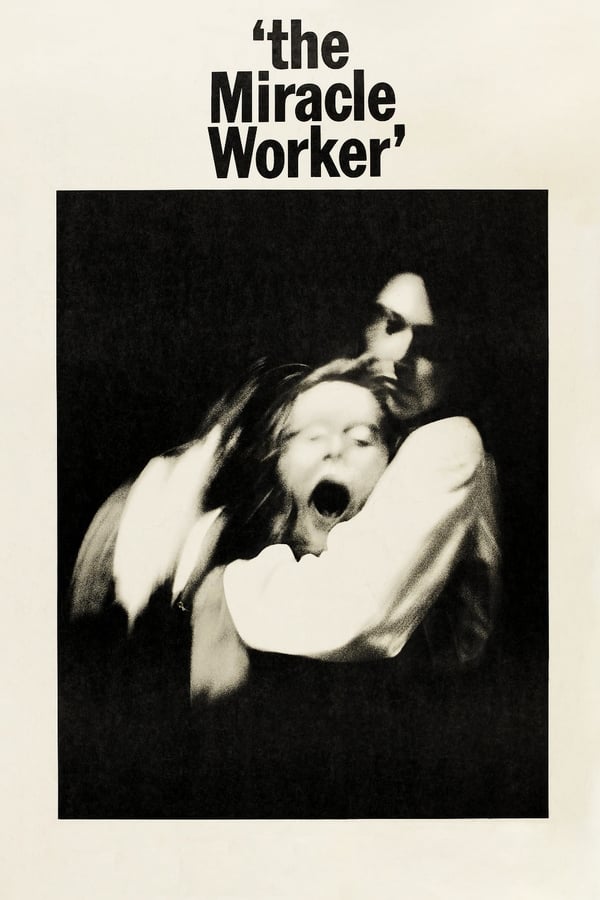




About the film
The true story of the frightening, lonely world of silence and darkness of 7-year-old Helen Keller who, since infancy, has never seen the sky, heard her mother's voice or expressed her innermost feelings. Then Annie Sullivan, a 20-year-old teacher from Boston, arrives. Having just recently regained her own sight, the no-nonsense Annie reaches out to Helen through the power of touch, the only tool they have in common, and leads her bold pupil on a miraculous journey from fear and isolation to happiness and light.
- Featured Lists
- National Film Registry
Year of Induction: 2024

Director: Stanley Kubrick
Sources: Criterion Forum (opens in a new tab)
> UK MoC 4K Blu-ray > Australia Imprint > US Kino Lorber better encoding
The MoC, Criterion and Imprint UHDs were encoded by FiM making all 3 very close. The higher bitrate helped in deciding and some luck; however Criterion is the most consistent one of all 3. Imprint has some scenes with more splotchy grain while MoC is quite close to Criterion but has some more blocking in dark scenes (e.g.: comp #27). With Criterion’s superior audio, it ensures complete consistency.
From cbc: "I'm personally quite fond of the restored track on Eureka's 4K Blu-ray. It does have spots with objectively worse fidelity, but for the most part, it sounds a lot more natural and less shrill, particularly dialogue. It seems to be a new mixdown of stems. Technically a remix, so not everyone's cup of tea, but it's not revisionist like most new movie mixes tend to be"
Both Imprint (included in their set) and Capelight (on its own/individually) offer remastered BDs. All other BDs, including the one included in The Complete Kubrick, are sourced from the same older master from around 2010.

Director: John Boorman

Director: John Schlesinger
Sources: Criterion Forum (opens in a new tab) · Blu-ray.com (opens in a new tab)
2027 Criterion 4K Blu-ray
Included Imprint Blu-Ray also has markedly better image compression than the Criterion Blu-Ray, though do note the Imprint has some adjusted color grading within roughly the first five minutes of the film
https://forum.blu-ray.com/showpost.php?p=16775595&postcount=450
https://forum.blu-ray.com/showpost.php?p=24237074&postcount=73

Director: Arthur Penn

Director: Stanley Kubrick
Sources: Criterion Forum (opens in a new tab)
Included in the Complete Kubrick box set with FiM encode of the same master from the Universal release without the filtering.
DTS:X mix on Universal 4K Blu-ray most closely approximates original surround mix
Criterion DVD and Universal 4K Blu-ray has additional features not found on the Criterion 4K Blu-ray

Director: Stanley Kubrick
Included in the Complete Kubrick box set with FiM encode of the same master from the WB release without the filtering, 1.85 ratio restored for US Cut; both US and International Cuts are 4K.
US Cut: 1999 WB DVD/Criterion 4K Blu-ray
No Blu-ray or DVD release until the Criterion 4K Blu-ray has presented the US in its original theatrical aspect ratio of 1.85:1. The International Cut has never been presented in it's OAR of 1.66:1 in any home video releases.
The packaging on the back of the WB 4K Blu-ray incorrectly states it as 1.85:1 when the movie is actually 1.78:1 as is the original Blu-ray.

Director: Stanley Kubrick
Sources: Criterion Forum (opens in a new tab) · slow.pics (opens in a new tab)
Included in the Complete Kubrick box set with FiM encode of the same master from the Sony release without the filtering; Comparison between Sony and Criterion.
Mono: 1994 LaserDisc (marginally, unfiltered) or Criterion 4K Blu-ray (filtered)
5.1 Remix: Criterion 4K Blu-ray

Director: Stanley Kubrick
Sources: slow.pics (opens in a new tab)
Included in the Complete Kubrick box set with FiM encode of the same master from the WB release without the filtering Comparison between the Criterion and WB.
5.1: WB 4K Blu-ray, a remix but has higher fidelity
Mono: Criterion 4K Blu-ray (restored for the box set)

Sources: slow.pics (opens in a new tab)
Included in the Complete Kubrick box set with FiM encode of the same master from the WB release without the filtering; WB 4K early pressing has errors of a shot, later pressings fixed. Comparison between Criterion and WB.
6-Track 70mm mix: Criterion 4K Blu-ray (restored for the box set), 1997 MGM LaserDisc, 1998 MGM DVD
35mm Mono Mix: Criterion 4K Blu-ray
Matrixed Stereo Remix: MGM Japan LaserDisc (1985) [G158F5509]
5.1 Remix: Criterion 4K Blu-ray

Director: Steve James

Director: Arthur Penn
Sources: Criterion Forum (opens in a new tab) · slow.pics (opens in a new tab) · blah-ray.blogspot.com (opens in a new tab)

Director: Arthur Penn

Sources: Criterion Forum (opens in a new tab) · DVDBeaver (opens in a new tab)
> Germany Wicked Vision Blu-ray > US Flicker Alley Blu-ray see DVDBeaver caps

Sources: Criterion Forum (opens in a new tab) · Blu-ray.com (opens in a new tab)
Flicker Alley 4K confirmed for 2027 https://forum.blu-ray.com/showpost.php?p=24404584&postcount=1
MoC audio is better https://forum.blu-ray.com/showthread.php?t=225532&page=3

Director: Paul Leni
Theatrical/Original A negative: MoC Blu-ray
European C/D negative but better picture quality: Kino Lorber 4K Blu-ray
Sources: slow.pics (opens in a new tab)
From DVDBeaver: The MoC Blu-ray is scanned from the American A negative, as opposed to the European C or D negatives used by Photoplay and others (Kino Lorber 4K Blu-ray), so it is identical with the film US audiences saw in 1927
See caps for comparison
In addition, the Kino Lorber 4K Blu-ray has sepia tinting throughout while the MoC Blu-ray has yellow for normal scenes, blue for night scenes, and some even green tintings.

Director: Louis Feuillade

Director: John Frankenheimer

Director: Hal Ashby

Director: Josef von Sternberg
Sources: DVDBeaver (opens in a new tab)
MoC slightly better than Kino Lorber http://www.dvdbeaver.com/film6/blu-ray_reviews_76/anatahan_blu-ray.htm

Director: Fritz Lang
1984 Giorgio Moroder restoration: MoC Blu-ray or Kino Lorber Blu-ray
2001 Murnau restoration: MoC 2-disc DVD set > Kino Lorber 1-disc Restored Authorized Edition DVD
2010 Murnau complete restoration: MoC Blu-ray > Kino Lorber Blu-ray

Director: Kenji Mizoguchi
Sources: Criterion Forum (opens in a new tab) · slow.pics (opens in a new tab)
Eureka MoC Blu-ray, see caps
MoC is sourced from an earlier scan, but still looks more detailed than the later 4K restoration released by Kadokawa in Japan, which has some black crush and DNR. French Capricci disc is sourced from the same scan as MoC but with much worse encoding and wrong levels.
1991 Daiei LaserDisc

Edit history

Every recommendation follows the same method — how these calls are made.