


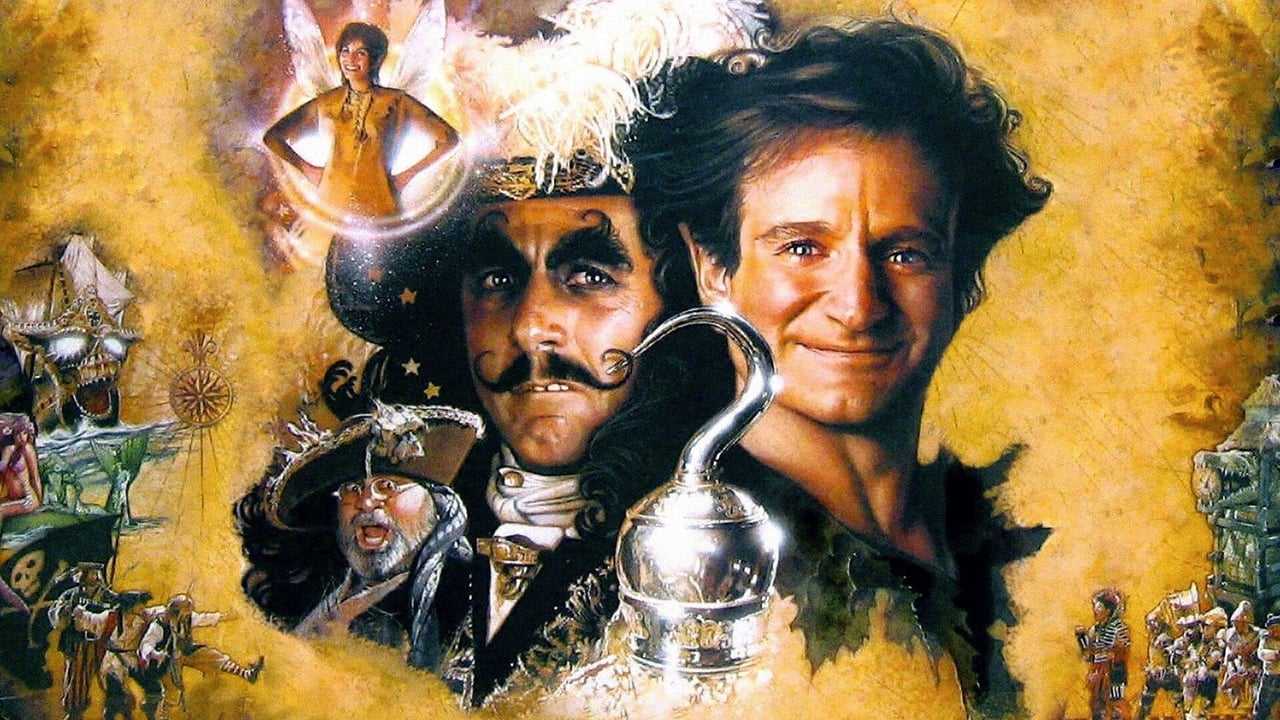
Hook (1991)
Adventure, Fantasy, Comedy, Family • 2h 22m
Overview
The boy who wasn't supposed to grow up—Peter Pan—does just that, becoming a soulless corporate lawyer whose workaholism could cost him his wife and kids. During his trip to see Granny Wendy in London, the vengeful Capt. Hook kidnaps Peter's kids and forces Peter to return to Neverland.
Director: Steven Spielberg
Cast: Dustin Hoffman, Robin Williams, Julia Roberts, Bob Hoskins, Maggie Smith, Caroline Goodall, Charlie Korsmo, Amber Scott, Laurel Cronin, Phil Collins, Arthur Malet, Isaiah Robinson, Jasen Fisher, Dante Basco, Raushan Hammond, James Madio, Thomas Tulak, Alex Zuckerman, Ahmad Stoner, Bogdan Georghe, Adam McNatt, René González Jr., Brian Willis, Brett Willis, Ryan Francis, Max Hoffman, Kelly Rowan, Stephanie Furst, Shannon Marie Kies, Regina Russell Banali, Jewel Newlander Hubbard, Jeannine Renshaw, Rebecca Hoffman, Jeannine Wagner, Francesca Serrano, Kevin Gasca, Andre Bollinger, Lauren Friedler-Gow, Bryce Armstrong, Margie Takeda, Alyson Healing, Zoe Koehler, Scott Williamson, Wayne Aten, Michael Hirshenson, Jake Hoffman, Geoffrey Lower, Don S. Davis, Cameron Thor, Brad Blumenthal, Brenda Isaacs Booth, Jan Cobler, Ruth de Sosa, Stuart White, Gwyneth Paltrow, Don McLeod, Kim O'Kelley, Beverly Polcyn, Randi Cee, Mary Bond Davis, David Crosby, Nick Tate, Tony Burton, Glenn Close, Nick Ullett, Matthew Van Ginkel, Ray Tveden, Kim Robillard, Michael Runyard, Gary Epper, Jeff Bornstein, Carrie Fisher, George Lucas, Jimmy Buffett, Mark Winn




The new Universal 4K is AI upscaled https://slow.pics/c/5jD2BjKT and sharpened, see discussion on BR https://forum.blu-ray.com/showthread.php?t=377660&page=9
The new Universal 4K is AI upscaled https://slow.pics/c/5jD2BjKT and sharpened, see discussion on BR https://forum.blu-ray.com/showthread.php?t=377660&page=9

Director: Steven Spielberg
Director: Steven Spielberg

35mm/70mm scan, Japan WOWOW Broadcast version, letterbox LaserDisc or DVD for purist version, Paramount 4K Blu-ray heavily revisionist
35mm/70mm scan, Japan WOWOW Broadcast version, letterbox LaserDisc or DVD for purist version, Paramount 4K Blu-ray heavily revisionist
1992 LaserDisc Dolby Surround, DVD 5.1 (70mm mix), 1991 Japan LaserDisc PCM (Dolby Stereo home version)
The Paramount 4K master is HEAVILY revisionist in that all of the effects and opticals were redone and tweaked with errors and issues. There has been grain management (moments of stagnating grain and haloing) and the encoding isn't great hence the typical Paramount noise in the image. (especially skies) The HDR is a bit bright in the highlights. The color timing and Atmos remix are thankfully taming the excessively overdone terrible Blu-ray in those areas but neither is fully accurate. The Atmos remix sounds lifeless and essentially tames the crazy LFE of the Blu-ray remix that never stopped while also spreading the sound around overhead. The music is absolutely lifeless here. If it weren't for the visual changes it might be possible to regrade the picture master and just live with the encoding noise. As it is, purists will want the LaserDisc, DVD or Japan WOWOW broadcast of the Laser Pacific master which is the same master used for the awful Blu-ray just without the hideous color grading applied.
The DVD was handled by Lowry Digital and is overscrubbed like crazy plus had all sorts of DVD era edge enhancement and other issues. It instigated the digital changes of the boulder rod and snake reflection removals. The ONLY widescreen versions of the film without ANY changes are the 1992 LaserDisc and the 1999 final release VHS.
Audio wise, Raiders is EXTREMELY complex. Like the Star Wars trilogy it had three specific release mixes with variations and differences plus a fourth mix that was not used. The mono mix had unique bits and has never been officially released though you can hear bits of it on the 2003 bonus DVD and in the Raiders in Concert live symphony performances. The Dolby Stereo is roughly what was used on all pre-widescreen editions on VHS, Beta and LaserDisc in the 80's. The best iteration of that is the 1991 Japan LaserDisc reissue with PCM digital sound. This iteration is more of a home version as it doesn't really have much surround. Yet it retains dynamic range unlike the 1985 home video remix of Star Wars' Dolby Stereo track. The 70mm Dolby six track magnetic audio was supposedly used in making the excellent sounding 5.1 made for the DVD release. Before the release the film was mixed in the very short lived VistaSonic process which was Paramount backed. This was dropped very last minute as the system had tons of playback issues and the film was apparently hastily remixed in Dolby formats. When the first letterboxed transfer showed up on the 1992 Paramount LaserDisc release all of a sudden the Dolby Surround encoded matrix track it contained is without question the best sounding mix of Raiders you can find anywhere. It is more aggressive than the Dolby Stereo, more punchy than the DVD 5.1 and even contains a unique different sound effect which indicates it is clearly a different mix. It is unknown if this is the abandoned VistaSonic mix or a new quiet Dolby Surround home mix akin to the 1993 Star Wars Definitive Collection remix. To this day, the LaserDisc Dolby surround is the best sounding version of Raiders you are likely ever to hear. Even though it isn't discrete.
The Blu-ray remix though supervised by Ben Burtt went overboard on making everything aggressive and modernized. The LFE is virtually nonstop even in dialogue scenes. It is a textbook case of revisionist audio desecration. The 4K Blu-ray Atmos merely tames the LFE and reduces impact even more by moving around more elements and adding more processing. Both of these remixes are a crime.
DFIC extensive review: https://youtu.be/evsrJOTIjdA
35mm/70mm scan, Japan WOWOW Broadcast version, letterbox LaserDisc or DVD for purist version, Paramount 4K Blu-ray heavily revisionist
35mm/70mm scan, Japan WOWOW Broadcast version, letterbox LaserDisc or DVD for purist version, Paramount 4K Blu-ray heavily revisionist
1992 LaserDisc Dolby Surround, DVD 5.1 (70mm mix), 1991 Japan LaserDisc PCM (Dolby Stereo home version)
The Paramount 4K master is HEAVILY revisionist in that all of the effects and opticals were redone and tweaked with errors and issues. There has been grain management (moments of stagnating grain and haloing) and the encoding isn't great hence the typical Paramount noise in the image. (especially skies) The HDR is a bit bright in the highlights. The color timing and Atmos remix are thankfully taming the excessively overdone terrible Blu-ray in those areas but neither is fully accurate. The Atmos remix sounds lifeless and essentially tames the crazy LFE of the Blu-ray remix that never stopped while also spreading the sound around overhead. The music is absolutely lifeless here. If it weren't for the visual changes it might be possible to regrade the picture master and just live with the encoding noise. As it is, purists will want the LaserDisc, DVD or Japan WOWOW broadcast of the Laser Pacific master which is the same master used for the awful Blu-ray just without the hideous color grading applied.
The DVD was handled by Lowry Digital and is overscrubbed like crazy plus had all sorts of DVD era edge enhancement and other issues. It instigated the digital changes of the boulder rod and snake reflection removals. The ONLY widescreen versions of the film without ANY changes are the 1992 LaserDisc and the 1999 final release VHS.
Audio wise, Raiders is EXTREMELY complex. Like the Star Wars trilogy it had three specific release mixes with variations and differences plus a fourth mix that was not used. The mono mix had unique bits and has never been officially released though you can hear bits of it on the 2003 bonus DVD and in the Raiders in Concert live symphony performances. The Dolby Stereo is roughly what was used on all pre-widescreen editions on VHS, Beta and LaserDisc in the 80's. The best iteration of that is the 1991 Japan LaserDisc reissue with PCM digital sound. This iteration is more of a home version as it doesn't really have much surround. Yet it retains dynamic range unlike the 1985 home video remix of Star Wars' Dolby Stereo track. The 70mm Dolby six track magnetic audio was supposedly used in making the excellent sounding 5.1 made for the DVD release. Before the release the film was mixed in the very short lived VistaSonic process which was Paramount backed. This was dropped very last minute as the system had tons of playback issues and the film was apparently hastily remixed in Dolby formats. When the first letterboxed transfer showed up on the 1992 Paramount LaserDisc release all of a sudden the Dolby Surround encoded matrix track it contained is without question the best sounding mix of Raiders you can find anywhere. It is more aggressive than the Dolby Stereo, more punchy than the DVD 5.1 and even contains a unique different sound effect which indicates it is clearly a different mix. It is unknown if this is the abandoned VistaSonic mix or a new quiet Dolby Surround home mix akin to the 1993 Star Wars Definitive Collection remix. To this day, the LaserDisc Dolby surround is the best sounding version of Raiders you are likely ever to hear. Even though it isn't discrete.
The Blu-ray remix though supervised by Ben Burtt went overboard on making everything aggressive and modernized. The LFE is virtually nonstop even in dialogue scenes. It is a textbook case of revisionist audio desecration. The 4K Blu-ray Atmos merely tames the LFE and reduces impact even more by moving around more elements and adding more processing. Both of these remixes are a crime.
DFIC extensive review: https://youtu.be/evsrJOTIjdA

Paramount 4K Blu-ray Purist choice: Blu-ray
Paramount 4K Blu-ray new improved master with color grading and slight issues. Blu-ray is old master with original color grading
Blu-ray 5.1
The Paramount 4K Blu-ray has a much better new scan that removes the original extremely dated color grading. This is an improvement on one hand but a definite revisionist change on the other. There is the expected grain management and slight HDR issues in addition to encoding quirks from Paramount. It is a giant improvement over the original Blu-ray but the color change and other issues means that the Blu-ray is one to keep for purists to have the as-is original iteration of the film's presentation. Audio wise the film has been remixed into Atmos but it merely seems like a slightly tweaked and frankly tamed version of the original 5.1. Of the two I prefer the Blu-ray 5.1. The original Blu-ray was Dolby TrueHD and the reissue Blu-ray in the four film Blu-ray collection boxset was DTS-HDMA.
DFIC extensive review: https://youtu.be/evsrJOTIjdA?si=wtdWGxZBfhPYTIeW
Paramount 4K Blu-ray Purist choice: Blu-ray
Paramount 4K Blu-ray new improved master with color grading and slight issues. Blu-ray is old master with original color grading
Blu-ray 5.1
The Paramount 4K Blu-ray has a much better new scan that removes the original extremely dated color grading. This is an improvement on one hand but a definite revisionist change on the other. There is the expected grain management and slight HDR issues in addition to encoding quirks from Paramount. It is a giant improvement over the original Blu-ray but the color change and other issues means that the Blu-ray is one to keep for purists to have the as-is original iteration of the film's presentation. Audio wise the film has been remixed into Atmos but it merely seems like a slightly tweaked and frankly tamed version of the original 5.1. Of the two I prefer the Blu-ray 5.1. The original Blu-ray was Dolby TrueHD and the reissue Blu-ray in the four film Blu-ray collection boxset was DTS-HDMA.
DFIC extensive review: https://youtu.be/evsrJOTIjdA?si=wtdWGxZBfhPYTIeW

Paramount 4K Blu-ray heavily revisionist. Purist option: 35mm scan, Blu-ray, DVD or LaserDisc
The Paramount 4K master is HEAVILY revisionist in that all of the effects and opticals were redone and tweaked with errors and issues. There has been grain management (moments of stagnating grain and haloing) and the encoding isn't great hence the typical Paramount noise in the image. (especially skies) The HDR is a bit bright in the highlights. The Blu-ray is showing its age but does not have any of these digital alterations. It is from the scan done by Laser Pacific and is the highest quality unaltered master we have. The DVD was done by Lowry Digital and had much scrubbing and processing of grain in addition to edge enhancement. The letterbox LaserDisc was the first widescreen release and is very good for its time. There was also a rare SVHS release using the letterbox LaserDisc master.
The 4K Blu-ray audio is seemingly an Atmos remix of the 5.1 found on the Blu-ray which itself is very similar to the DVD 5.1. All are presumably based on the 70mm Dolby six track mix. The Atmos is more processed and moves the sound around more so it is inferior to the older 5.1 iterations. On release, Last Crusade had Dolby 70mm with stereo surrounds, Dolby Stereo SR for 35mm and was mixed in a THX sound theater to ensure the ultimate in technical quality in 1989. The DVD was supposedly made from the 70mm mix and the Blu-ray 5.1 seems to bring that into lossless. This is unconfirmed but each seems to be a healthy and accurate version of the original audio. However, the LaserDisc despite only having matrix PCM stereo is punchier and livelier as a listening experience. Despite not being discrete it arguably sounds better than the 5.1 versions. Some who remember seeing each of the original release versions claim to remember the 35mm Dolby DR as sounding better than the 70mm Dolby. This is a case where both sound great and it's up to fans to decide which they prefer. Both are essential for any Indy collection and the LaserDisc is very cheap. The VHS hifi seems to be the same 2.0 matrix with format differences so it can also be compared against the DVD and Blu-ray 5.1 versions.
DFIC extensive review: https://youtu.be/evsrJOTIjdA?si=wtdWGxZBfhPYTIeW
Paramount 4K Blu-ray heavily revisionist. Purist option: 35mm scan, Blu-ray, DVD or LaserDisc
The Paramount 4K master is HEAVILY revisionist in that all of the effects and opticals were redone and tweaked with errors and issues. There has been grain management (moments of stagnating grain and haloing) and the encoding isn't great hence the typical Paramount noise in the image. (especially skies) The HDR is a bit bright in the highlights. The Blu-ray is showing its age but does not have any of these digital alterations. It is from the scan done by Laser Pacific and is the highest quality unaltered master we have. The DVD was done by Lowry Digital and had much scrubbing and processing of grain in addition to edge enhancement. The letterbox LaserDisc was the first widescreen release and is very good for its time. There was also a rare SVHS release using the letterbox LaserDisc master.
The 4K Blu-ray audio is seemingly an Atmos remix of the 5.1 found on the Blu-ray which itself is very similar to the DVD 5.1. All are presumably based on the 70mm Dolby six track mix. The Atmos is more processed and moves the sound around more so it is inferior to the older 5.1 iterations. On release, Last Crusade had Dolby 70mm with stereo surrounds, Dolby Stereo SR for 35mm and was mixed in a THX sound theater to ensure the ultimate in technical quality in 1989. The DVD was supposedly made from the 70mm mix and the Blu-ray 5.1 seems to bring that into lossless. This is unconfirmed but each seems to be a healthy and accurate version of the original audio. However, the LaserDisc despite only having matrix PCM stereo is punchier and livelier as a listening experience. Despite not being discrete it arguably sounds better than the 5.1 versions. Some who remember seeing each of the original release versions claim to remember the 35mm Dolby DR as sounding better than the 70mm Dolby. This is a case where both sound great and it's up to fans to decide which they prefer. Both are essential for any Indy collection and the LaserDisc is very cheap. The VHS hifi seems to be the same 2.0 matrix with format differences so it can also be compared against the DVD and Blu-ray 5.1 versions.
DFIC extensive review: https://youtu.be/evsrJOTIjdA?si=wtdWGxZBfhPYTIeW

Paramount 4K Blu-ray heavily revisionist. Purist option: 35mm scan, Blu-ray, DVD or LaserDisc.
The Paramount 4K master is HEAVILY revisionist in that all of the effects and opticals were redone and tweaked with errors and issues. There has been grain management (moments of stagnating grain and haloing) and the encoding isn't great hence the typical Paramount noise in the image. (especially skies) The HDR is a bit bright in the highlights. The Blu-ray is showing its age but does not have any of these digital alterations. It is from the scan done by Laser Pacific and is the highest quality unaltered master we have. The DVD was done by Lowry Digital and had much scrubbing and processing of grain in addition to edge enhancement. The letterbox LaserDisc was the first widescreen release and is very good for its time.
The 4K Blu-ray audio is seemingly an Atmos remix of the 5.1 found on the Blu-ray which itself is very similar to the DVD 5.1. All are presumably based on the 70mm Dolby six track mix. The Atmos is more processed and moves the sound around more so it is inferior to the older 5.1 iterations. On release Temple of Doom had 70mm, 35mm Dolby Stereo and mono mixes. The mono was for 16mm and other outlets and is presumably close to if not a mixdown of the stereo. It is seemingly the last Lucasfilm title that had a mono mix made. The Dolby Stereo is one of the most aggressive matrix mixes ever made and is still a blast to this day on the letterbox LaserDisc release. It is more aggressive than any of the 5.1 discrete versions which is either due to studios taming the audio later or the 35mm mix being handled a bit differently to the 70mm mix. In terms of releases today, the LaserDisc still sounds better than DVD, Blu-ray or 4K Blu-ray because of this factor.
DFIC extensive review: https://youtu.be/evsrJOTIjdA?si=wtdWGxZBfhPYTIeW
Paramount 4K Blu-ray heavily revisionist. Purist option: 35mm scan, Blu-ray, DVD or LaserDisc.
The Paramount 4K master is HEAVILY revisionist in that all of the effects and opticals were redone and tweaked with errors and issues. There has been grain management (moments of stagnating grain and haloing) and the encoding isn't great hence the typical Paramount noise in the image. (especially skies) The HDR is a bit bright in the highlights. The Blu-ray is showing its age but does not have any of these digital alterations. It is from the scan done by Laser Pacific and is the highest quality unaltered master we have. The DVD was done by Lowry Digital and had much scrubbing and processing of grain in addition to edge enhancement. The letterbox LaserDisc was the first widescreen release and is very good for its time.
The 4K Blu-ray audio is seemingly an Atmos remix of the 5.1 found on the Blu-ray which itself is very similar to the DVD 5.1. All are presumably based on the 70mm Dolby six track mix. The Atmos is more processed and moves the sound around more so it is inferior to the older 5.1 iterations. On release Temple of Doom had 70mm, 35mm Dolby Stereo and mono mixes. The mono was for 16mm and other outlets and is presumably close to if not a mixdown of the stereo. It is seemingly the last Lucasfilm title that had a mono mix made. The Dolby Stereo is one of the most aggressive matrix mixes ever made and is still a blast to this day on the letterbox LaserDisc release. It is more aggressive than any of the 5.1 discrete versions which is either due to studios taming the audio later or the 35mm mix being handled a bit differently to the 70mm mix. In terms of releases today, the LaserDisc still sounds better than DVD, Blu-ray or 4K Blu-ray because of this factor.
DFIC extensive review: https://youtu.be/evsrJOTIjdA?si=wtdWGxZBfhPYTIeW

Universal 4K Blu-ray Trilogy Steelbook 2025, but has more DNR than old 4K
Universal 4K Blu-ray Trilogy Steelbook 2025, but has more DNR than old 4K
https://forum.blu-ray.com/showpost.php?p=23286334&postcount=7340
Universal 4K Blu-ray Trilogy Steelbook 2025, but has more DNR than old 4K
Universal 4K Blu-ray Trilogy Steelbook 2025, but has more DNR than old 4K
https://forum.blu-ray.com/showpost.php?p=23286334&postcount=7340

Director: Steven Spielberg
"Director's Cut" (Theatrical cut with minor changes): Universal 4K Blu-ray
Theatrical Cut: VHS
TV Cut: Fan restoration
"Director's Cut" (Theatrical cut with minor changes): Universal 4K Blu-ray
Theatrical Cut: VHS TV Cut: Fan restoration
1993 MCA LaserDisc (with EQ adjusted)
Director: Steven Spielberg
"Director's Cut" (Theatrical cut with minor changes): Universal 4K Blu-ray
Theatrical Cut: VHS
TV Cut: Fan restoration
"Director's Cut" (Theatrical cut with minor changes): Universal 4K Blu-ray
Theatrical Cut: VHS TV Cut: Fan restoration
1993 MCA LaserDisc (with EQ adjusted)

Director: Steven Spielberg
Director: Steven Spielberg

Director: Steven Spielberg
2D version: Warner Bros 4K Blu-ray
3D version: Warner Bros 3D Blu-ray or Apple Vision Pro
2D version: Warner Bros 4K Blu-ray
3D version: Warner Bros 3D Blu-ray or Apple Vision Pro
Director: Steven Spielberg
2D version: Warner Bros 4K Blu-ray
3D version: Warner Bros 3D Blu-ray or Apple Vision Pro
2D version: Warner Bros 4K Blu-ray
3D version: Warner Bros 3D Blu-ray or Apple Vision Pro

Directors: Frank Oz & Jim Henson
Directors: Frank Oz & Jim Henson

Director: Jim Henson
Shout! Factory replacement 4K Blu-ray
Shout! Factory replacement 4K Blu-ray, Shout! Factory doesn't have the low-pass filter that's on the Sony US 4K Blu-ray from 2021 with Dolby Vision (or the worse HDR10 only release from 2016). Shout! Factory retains more high-frequency grain and detail.
Embassy Home Entertainment JPN LaserDisc or 1999 Sony US DVD 2.0
Director: Jim Henson
Shout! Factory replacement 4K Blu-ray
Shout! Factory replacement 4K Blu-ray, Shout! Factory doesn't have the low-pass filter that's on the Sony US 4K Blu-ray from 2021 with Dolby Vision (or the worse HDR10 only release from 2016). Shout! Factory retains more high-frequency grain and detail.
Embassy Home Entertainment JPN LaserDisc or 1999 Sony US DVD 2.0

Director: Luc Besson
2020 StudioCanal 4K Blu-ray vs 2017 Sony 4K Blu-ray (20th annivesary) vs 2025 Sony 4K Blu-ray (Luc Besson Box Set). The first two have totally different texture.
StudioCanal: More natural looking. Better defined grain. The white balance is rather yellow/orange. Some say it is closer to the original theatrical release.
2017 Sony: More vibrant and impactful. The white balance is rather neutral. While color noise and grain can look busy because it had been sharpened and had micro-contrast boosted.
2025 Sony: Supposedly an improved version of the 2017 release? Shows around 20mbps-higher overall video bitrate. caps
2025 Sony US 4K Blu-ray has the original 5.1.
The Atmos on the Sony release is reportedly better than StudioCanal's.
Disc info of the box set discs. This film have recieved multiple encode/versions in different regions over the years. The 2017 Germany4K Blu-ray is encoded differently than the 2017 Sony but not better. Also, the same can be said to 2024 France Gaumont 4K Blu-ray while comparing to the 2020 StudioCanal 4K Blu-ray. The StudioCanal 4K Blu-ray omits all the extras from previous releases, being barebones.
Director: Luc Besson
2020 StudioCanal 4K Blu-ray vs 2017 Sony 4K Blu-ray (20th annivesary) vs 2025 Sony 4K Blu-ray (Luc Besson Box Set). The first two have totally different texture.
StudioCanal: More natural looking. Better defined grain. The white balance is rather yellow/orange. Some say it is closer to the original theatrical release.
2017 Sony: More vibrant and impactful. The white balance is rather neutral. While color noise and grain can look busy because it had been sharpened and had micro-contrast boosted.
2025 Sony: Supposedly an improved version of the 2017 release? Shows around 20mbps-higher overall video bitrate. caps
2025 Sony US 4K Blu-ray has the original 5.1.
The Atmos on the Sony release is reportedly better than StudioCanal's.
Disc info of the box set discs. This film have recieved multiple encode/versions in different regions over the years. The 2017 Germany4K Blu-ray is encoded differently than the 2017 Sony but not better. Also, the same can be said to 2024 France Gaumont 4K Blu-ray while comparing to the 2020 StudioCanal 4K Blu-ray. The StudioCanal 4K Blu-ray omits all the extras from previous releases, being barebones.

Director: Will Gluck
Director: Will Gluck

Director: George Sidney
Director: George Sidney


Director: Jack White
Director: Jack White

Director: Will Gluck
Sony 4K Blu-ray see comparison
The 4K Blu-ray is low-passed, Sony Pictures Core Streaming is heavily DNR
Director: Will Gluck
Sony 4K Blu-ray see comparison
The 4K Blu-ray is low-passed, Sony Pictures Core Streaming is heavily DNR


Director: Danny Boyle
Sony 4K Blu-ray see caps
Recovers quite a bit of highlight detail, looks less harsh and clipped in the video footage than the old BD.
Dolby Atmos Remix: Sony 4K Blu-ray
Original 5.1 mix: old OOP Fox Blu-ray
5.1 on the 4K is a downmix of the Atmos remix.
Director: Danny Boyle
Sony 4K Blu-ray see caps
Recovers quite a bit of highlight detail, looks less harsh and clipped in the video footage than the old BD.
Dolby Atmos Remix: Sony 4K Blu-ray
Original 5.1 mix: old OOP Fox Blu-ray
5.1 on the 4K is a downmix of the Atmos remix.
More Adventure on Blu-ray

Directors: Neil Nightingale & Barry Cook
Fox 3D Blu-ray has both the theatrical cut and the "Cretaceous Cut"
Fox 3D Blu-ray has both the theatrical cut and the "Cretaceous Cut" which removes the dialogue and the framing device, essentially serving as a director's cut of the film. The "Cretaceous Cut" is not available on the 2D Blu-ray or on digital streaming.
Directors: Neil Nightingale & Barry Cook
Fox 3D Blu-ray has both the theatrical cut and the "Cretaceous Cut"
Fox 3D Blu-ray has both the theatrical cut and the "Cretaceous Cut" which removes the dialogue and the framing device, essentially serving as a director's cut of the film. The "Cretaceous Cut" is not available on the 2D Blu-ray or on digital streaming.

France M6 4K Blu-ray has Dolby Vision, but is inferior with more washed out colors and inferior encoding plus no hardcoded subtitles for the Portuguese language parts
France M6 4K Blu-ray has Dolby Vision, but is inferior with more washed out colors and inferior encoding plus no hardcoded subtitles for the Portuguese language parts

Directors: Phil Lord & Christopher Miller
Amazon MGM 4K Blu-ray SteelBook with mixed aspect ratio 1.43:1/2.39:1
Directors: Phil Lord & Christopher Miller
Amazon MGM 4K Blu-ray SteelBook with mixed aspect ratio 1.43:1/2.39:1

Directors: Andrew Adamson & Vicky Jenson
2011 Blu-ray (4K Blu-ray is upscaled; former PDI animator Jonathan Gibbs confirms the film was originally rendered at 1828 pixels wide to save space)
Universal 25th Anniversary 4K Blu-ray with Dolby Vision and Atmos
2011 Blu-ray (4K Blu-ray is upscaled; former PDI animator Jonathan Gibbs confirms the film was originally rendered at 1828 pixels wide to save space)
The old 2 disc DVD has extras missing from 4K Blu-ray
Directors: Andrew Adamson & Vicky Jenson
2011 Blu-ray (4K Blu-ray is upscaled; former PDI animator Jonathan Gibbs confirms the film was originally rendered at 1828 pixels wide to save space)
Universal 25th Anniversary 4K Blu-ray with Dolby Vision and Atmos
2011 Blu-ray (4K Blu-ray is upscaled; former PDI animator Jonathan Gibbs confirms the film was originally rendered at 1828 pixels wide to save space)
The old 2 disc DVD has extras missing from 4K Blu-ray

Director: Fred M. Wilcox
2026 Arrow 4K Blu-ray
Director: Fred M. Wilcox
2026 Arrow 4K Blu-ray

2001 DVD for uncensored cut with rock and extras
Disney Blu-ray; 4K Blu-ray only has an Atmos remix with a phasing issue
2001 DVD for uncensored cut with rock and extras
Disney Blu-ray; 4K Blu-ray only has an Atmos remix with a phasing issue

Director: Robert Altman
Paramount Blu-ray
Popeye was mixed for a failed Vistasonic system with 4 discrete tracks (L/C/R/S). That mix has never been released on home video in its original form.
The older 5.1 track appearing on older DVD/BD releases sounds excellent. It appears to be a slight upmix of the original mix, only splitting the surrounds and adding LFE. It sounds close to the old analog LaserDisc, which is likely the original mix in a matrixed form.
The 5.1 included on the UHD is a new remix which significantly differs from previous tracks. There are new foley effects all over the place. Music is jarringly spliced in from different sources. Unlike the old 5.1 which had clearly discrete surrounds, the channels surrounds overlap somewhat with the fronts here.
Details on the new mix from Paramount's former head of restoration: https://youtu.be/P-AmjqViJyE?t=788
The 2.0 tracks on all DVDs/BDs are just downmixes of their respective 5.1 mixes.
Samples
Director: Robert Altman
Paramount Blu-ray
Popeye was mixed for a failed Vistasonic system with 4 discrete tracks (L/C/R/S). That mix has never been released on home video in its original form.
The older 5.1 track appearing on older DVD/BD releases sounds excellent. It appears to be a slight upmix of the original mix, only splitting the surrounds and adding LFE. It sounds close to the old analog LaserDisc, which is likely the original mix in a matrixed form.
The 5.1 included on the UHD is a new remix which significantly differs from previous tracks. There are new foley effects all over the place. Music is jarringly spliced in from different sources. Unlike the old 5.1 which had clearly discrete surrounds, the channels surrounds overlap somewhat with the fronts here.
Details on the new mix from Paramount's former head of restoration: https://youtu.be/P-AmjqViJyE?t=788
The 2.0 tracks on all DVDs/BDs are just downmixes of their respective 5.1 mixes.
Samples

Director: Phillip Noyce
Director: Phillip Noyce

Directors: Gary Trousdale & Kirk Wise
Directors: Gary Trousdale & Kirk Wise

Directors: Aaron Blaise & Robert Walker
Directors: Aaron Blaise & Robert Walker
Edit History
Made with ❤️ 📀 by vanshady